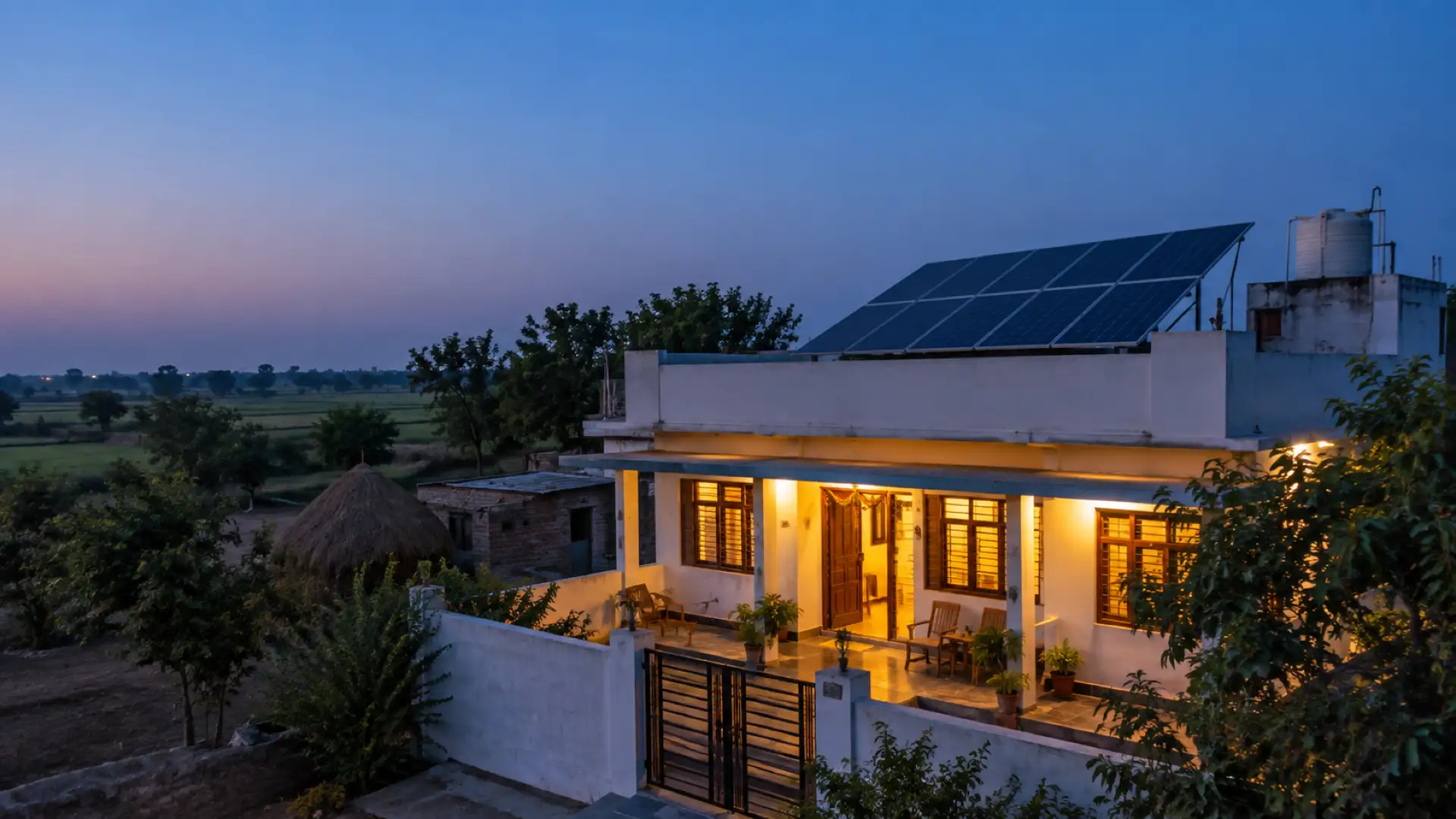
A rooftop-solar installer in India does not sell a product and walk away. Each customer passes through eight stages, from the first enquiry to the AMC visit years later, and three of them are paperwork that a government portal, a DISCOM and an MNRE notice put on a clock. Most firms of 5 to 20 people run all of it on WhatsApp chats, a shared sheet and the owner's memory. That works until the owner is on a roof, a subsidy file goes quiet for two months and the vendor rating on the national portal drops.
A solar CRM is the system that holds those eight stages in one place and tells each person what to do next. This guide sets out what it must do for an Indian rooftop installer, stage by stage, with what Raymitra does today and what it does not do yet.
The eight stages a solar CRM must hold
A general CRM stops at the deal. A solar business is only half done when the customer says yes: the subsidy file, the install, the net meter, the money and the service visits are still ahead. The test for any solar CRM is whether all eight stages share one customer record.
- Enquiry (“inquiry aayi”). Every enquiry lands on one board with a next step: the website form, a photo of the electricity bill, a pin on the map, or your old sheet imported. WhatsApp enquiries join the same board once your business number is connected.
- Site survey (“site visit”). The survey runs on the phone on the roof: roof and meter photos, the bill, sanctioned load, meter type and a GPS fix. Photos and forms wait on the phone when the signal drops and upload when it returns.
- Quote (“quotation”). Pick the kW. Panels, inverter, structure and labour come from your own price book; the subsidy and GST fill in from dated tables; the customer gets a branded PDF and a link on WhatsApp.
- Subsidy file (“subsidy aayi?”). One row per PM Surya Ghar application, with its portal stage, the date it entered that stage and how many days it has waited.
- Install (“installation”). Projects with ten milestones, the crew, dates and site photos, so the office knows what happened on the roof today.
- Money (“payment baaki”). GST invoices on the goods and services split, advance and milestone payments, and who still owes what.
- Stock (“material”). Panels, inverters and structure held, sent and fitted. This stage is next in Raymitra; it is not built yet, and we will not sell it until it is.
- After-sales (“AMC, cleaning, inverter fault”). AMC contracts with renewal dates, service tickets and maintenance visits, on the same customer record as the sale.
The PM Surya Ghar application tracker
The stage that costs installers the most is the one most tools leave out: the subsidy application after the sale. On the national portal an application moves through stages such as Registered, Feasibility, Vendor selected, Agreement approved, Installation uploaded, and each stage can stall at the DISCOM or on a document. An MNRE notice to registered vendors (MNRE notice, 24 Aug 2026) advises them not to keep a consumer application for more than 60 days without a valid reason, and the same notice deactivated underperforming vendors for a month.
So the tracker must age every application in days, not just list it. Raymitra keeps one row per application with its stage and the date it entered that stage. A row turns amber at 45 days, our own early warning, and red at 60, the limit in the notice; red is kept for that alone, so red always means act today. A rejection is a state on the record with its reason and the resubmission date, not a note in a chat. Raymitra does not file on the portal for you or read its status automatically; you file there, and the record here makes sure nothing ages unseen. Try the vendor 60-day check and the application risk calculator to see the rule on your own numbers.
Subsidy, state top-up and GST from dated tables
A quote that carries the wrong subsidy or the wrong GST is a dispute waiting to happen, and both change by notification. The central subsidy in Raymitra's table is ₹30,000 per kW from 0 to 2 kW, then ₹18,000 per kW from 2 to 3 kW, capped at ₹78,000, effective 13 Feb 2024, from the Guidelines for PM-Surya Ghar: Muft Bijli Yojana – Central Financial Assistance to Residential Consumers (MNRE). GST on a rooftop system is split: 70% goods at 5% and 30% services at 18%, a blended 8.9%, effective 22 Sep 2025 (CBIC Notification No. 9/2025-Integrated Tax (Rate)).
State top-ups are where tools drift most, because each state publishes its own order. Raymitra's table holds the top-up rule for 16 states, each with its source and the date it was checked, and a state with no top-up shows zero rather than an old number. Every quote keeps the rates it used, so a quote sent in March still reads the same in June. The free subsidy calculator and GST calculator run on the same table.
Hindi, Gujarati and English
Owners, sales staff and site engineers in the same firm do not all read the same language. Raymitra's screens are in Hindi, Gujarati and English, and each person picks their own. A solar CRM that is English-only gets used by the office and ignored on the roof.
What to check before you buy any solar CRM
- Open an application that has waited past the warning mark. What does the owner see, and where?
- Make a 3 kW quote. Which subsidy and which GST does it carry, and where is each rate set and dated?
- Who loads your price book and templates, you or the vendor, and how long does it take?
- Run the survey on a cheap Android phone with a weak signal.
- Is the price published, and do technicians need a paid login?
The full list of ten questions, with Raymitra's answer to each, is in the solar EPC software buyer's guide. If you are weighing a CRM against an ERP, read solar ERP or solar CRM. Setup is done for you: we import your sheet, load your price book and send your first quote with you on a call, ₹5,000 once and free for the first 20 customers.
Questions
What is a solar CRM?
Software that keeps every enquiry, survey, quote, subsidy application, install, payment and service visit of a solar installer on one customer record, and tells each person their next step.
Why not use a general CRM?
A general CRM stops at the deal. It does not know kW, sanctioned load, DISCOM, the PM Surya Ghar stages, the subsidy slabs or the GST split, so a firm ends up building all of that by hand.
Does Raymitra file my application on the PM Surya Ghar portal?
No. You file on the national portal; Raymitra keeps a record of each application with its stage and days pending, amber at 45 days and red at 60.
Which states does it cover?
The central subsidy applies everywhere. Raymitra's table holds the state top-up rule for 16 states, each with its source and date.
Is there a free trial?
Yes, 14 days with no card. Technician logins are always free.
No card needed. Technician logins always free.