रूफ़टॉप सोलर का कोटेशन 10 मिनट में: बिल से साइज़, सब्सिडी, GST और ग्राहक को कितना देना है, एक उदाहरण के साथ।
A customer reads a solar quotation for four numbers: the size, the subsidy, the GST and what they finally pay. Get those four right, and in the right order, and the quote is done. Get one wrong, and you lose the job or, worse, win it on a promise you cannot keep.
This post builds one quote end to end: a 3 kW rooftop system for a home in Gujarat. Every rupee comes from a government document, cited as we go. At the end is a plain-text quotation format you can copy.
The short answer
For a 3 kW system in Gujarat, using MNRE's benchmark cost as the price:
- System price: ₹1,45,000
- GST, on the 70:30 split: ₹12,905
- Total with GST: ₹1,57,905
- Central subsidy: minus ₹78,000
- Gujarat state top-up: none
- Net payable after subsidy: ₹79,905
Step 1: size the system from the bill
Ask for the electricity bill first. It carries the consumer number the portal registers against, the DISCOM, the sanctioned load and the units used. Take the average monthly units, from a year of bills if the customer has them.
Our example home uses 360 units a month. Size it like this:
- 360 units ÷ 30 days = 12 units a day
- 12 units ÷ 4 units per kW per day = 3 kW
The 4 is a planning figure, not a government average. MNRE says one kW "can generate 4 to 5.5 units in a day" on a clear sunny day (MNRE FAQ, via PIB). Cloudy and monsoon days pull the year down, so we plan at the low end.
Two checks before you go further:
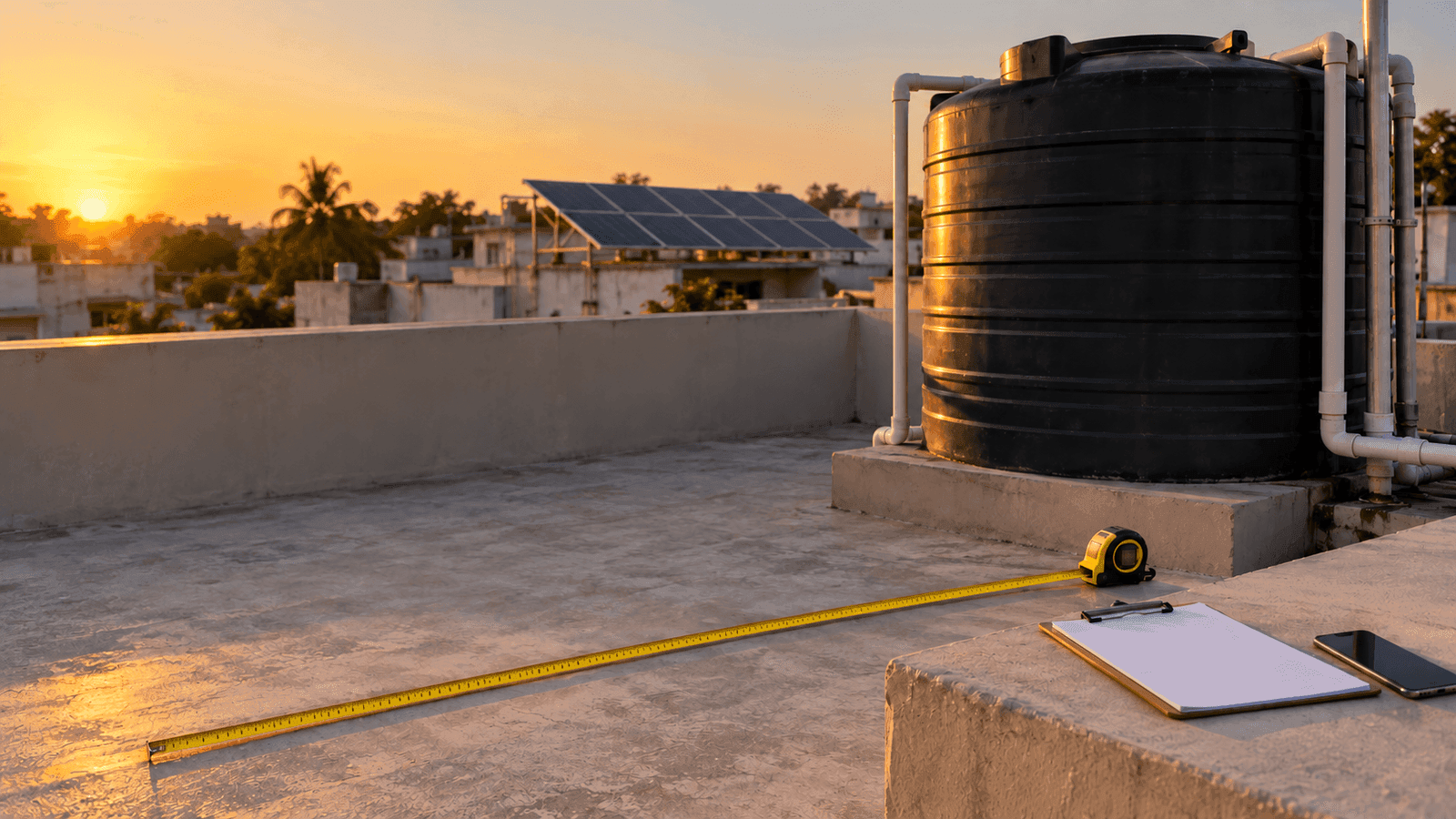
- Roof. MNRE's rule of thumb is 10 to 12 square metres of shadow-free area per kW, so 3 kW needs about 30 to 36 square metres, roughly 324 to 387 square feet.
- Load. In Gujarat a home's rooftop system is allowed "irrespective of consumer sanctioned load" (GERC net-metering regulations, third amendment, Reg 6.2(c)(i)). Single-phase supply covers an aggregate load up to 6 kW, so note the phase for the meter charges.
Step 2: write the BOM lines
The MNRE guidelines list what a rooftop system contains (clause 9). Those are your BOM lines:
- Solar modules, DCR: made in India from Indian cells, at least 3 kWp DC in total
- Inverter
- Module mounting structure
- Energy meter: net meter or generation meter
- Array junction box, DC distribution box, AC distribution box
- Earthing, lightning arrester and surge protection
- DC and AC cables
- Drawings and manuals
- Installation, plus five years of free repair and maintenance from commissioning, which a registered vendor must give (clause 7(d))
Two rules from clause 5 belong on the quote itself. The subsidy counts the modules' rated DC capacity, not the inverter's (clause 5(k)). And one non-DCR module "in any form" makes the whole system ineligible (clause 5(m)).
Your price book fills each line. For this example we use MNRE's benchmark cost for the whole system: ₹50,000 per kW for the first 2 kW and ₹45,000 for the third, so ₹1,45,000 (MNRE scheme guidelines, clause 5(g)). It is the reference the subsidy is set against, not a market price.
Step 3: the subsidy line
The central subsidy under PM Surya Ghar is ₹30,000 per kW for the first 2 kW and ₹18,000 for the third, capped at ₹78,000 (clause 5(h)):
- ₹30,000 × 2 + ₹18,000 × 1 = ₹78,000
A 4 kW or 5 kW system still gets ₹78,000.
The state line. Add a state top-up only where our rates file marks it verified from a government document. For Gujarat it is verified as none: the state's own orders paid "either of the state subsidy or MNRE subsidy, but not both", and the scheme ran "up to Financial Year 2024-25" (Gujarat Energy and Petrochemicals Department). Anywhere else, check your state before you write a figure. The subsidy calculator shows each state's flag, and the subsidy post covers the states that do add money.
Step 4: GST on the 70:30 split
A rooftop contract is not taxed at one rate. GST law deems 70% of the contract value to be the solar goods, taxed at 5%, and 30% to be the installation service, taxed at 18% (CBIC Notification 9/2025-Integrated Tax (Rate), entry 437):
- Goods: 70% of ₹1,45,000 = ₹1,01,500, at 5% = ₹5,075
- Service: 30% of ₹1,45,000 = ₹43,500, at 18% = ₹7,830
- GST: ₹12,905, which is 8.9% of the contract value
- Total with GST: ₹1,57,905
Show both GST lines on the quote. A single "GST 8.9%" line invites the question "why not 5%?". The GST post and the GST calculator go deeper.
Step 5: net payable, and when the money moves
- ₹1,57,905 − ₹78,000 = ₹79,905
Say plainly how the money moves. The customer pays you the full ₹1,57,905 on the schedule you agree. The ₹78,000 comes later, to the customer's bank account, after the DISCOM inspects and approves; MNRE processes it within 15 days of that approval (clause 6(t)). With a solar loan, it goes to the loan account first (clause 6(s)).
One line sits outside the system price. In DGVCL, MGVCL, PGVCL and UGVCL areas, the net-meter charges for a 1 to 6 kW PM Surya Ghar system are ₹2,950 (GUVNL letter of 15 February 2024). Torrent Power areas have their own amounts, covered in the 3 kW cost post. Confirm the figure when you apply.
Step 6: what the customer signs
- The vendor-consumer agreement. MNRE's model (Annexure 2 of the guidelines) covers the system, components, cost and payment schedule, the five-year warranty and maintenance, and that net-meter work and grid connection are the vendor's job.
- The portal approval. Since a portal notice of 23 September 2026, the vendor enters the total cost "inclusive of taxes and all charges" when uploading the agreement, and the customer must approve it from their own login before installation can be uploaded (PM Surya Ghar portal). Where a quotation was entered at feasibility, for a loan or above 10 kW, the two totals must match.
- No separate net-meter agreement in Gujarat. GERC has dropped the separate written connectivity agreement for PM Surya Ghar systems (GERC fifth amendment, clause 3).
So the total on your quote, in the agreement and on the portal should be one number.
A plain-text quotation format
Copy this, replace the square brackets, and keep the order:
QUOTATION No. [number]
Date: [date]
[Firm], PM Surya Ghar
registered vendor
Customer: [name]
Consumer no.: [number]
DISCOM: [name]

1. SYSTEM
3 kWp on-grid, DCR modules
Supply: [single/three] phase
Use: [units] units a month
Roof: [area] sq ft, no shade

2. BILL OF MATERIALS
DCR modules, [make]
  [qty] x [Wp] = [kWp] kWp DC
Inverter, [make], [kW]
Mounting structure, [type]
Net / generation meter
ACDB, DCDB, junction box
Earthing, lightning
  arrester, surge protection
DC and AC cables
Drawings and manuals
Installation
5 years free repair and
  maintenance

3. PRICE
System price    Rs 1,45,000
GST goods       Rs     5,075
  (70% at 5%)
GST services    Rs     7,830
  (30% at 18%)
Total with GST  Rs 1,57,905
Central subsidy Rs   -78,000
State top-up    None (GJ)
NET PAYABLE     Rs    79,905

4. NOT IN THE PRICE
Net-meter charges Rs [amt]
  (confirm at application)

5. PAYMENT SCHEDULE
[milestones agreed]

6. NOTES
The subsidy goes to the
customer's bank account
after DISCOM inspection
and approval. The total
above is the total on the
PM Surya Ghar portal.

Signed: [vendor]
Accepted: [customer]
Doing it in Raymitra
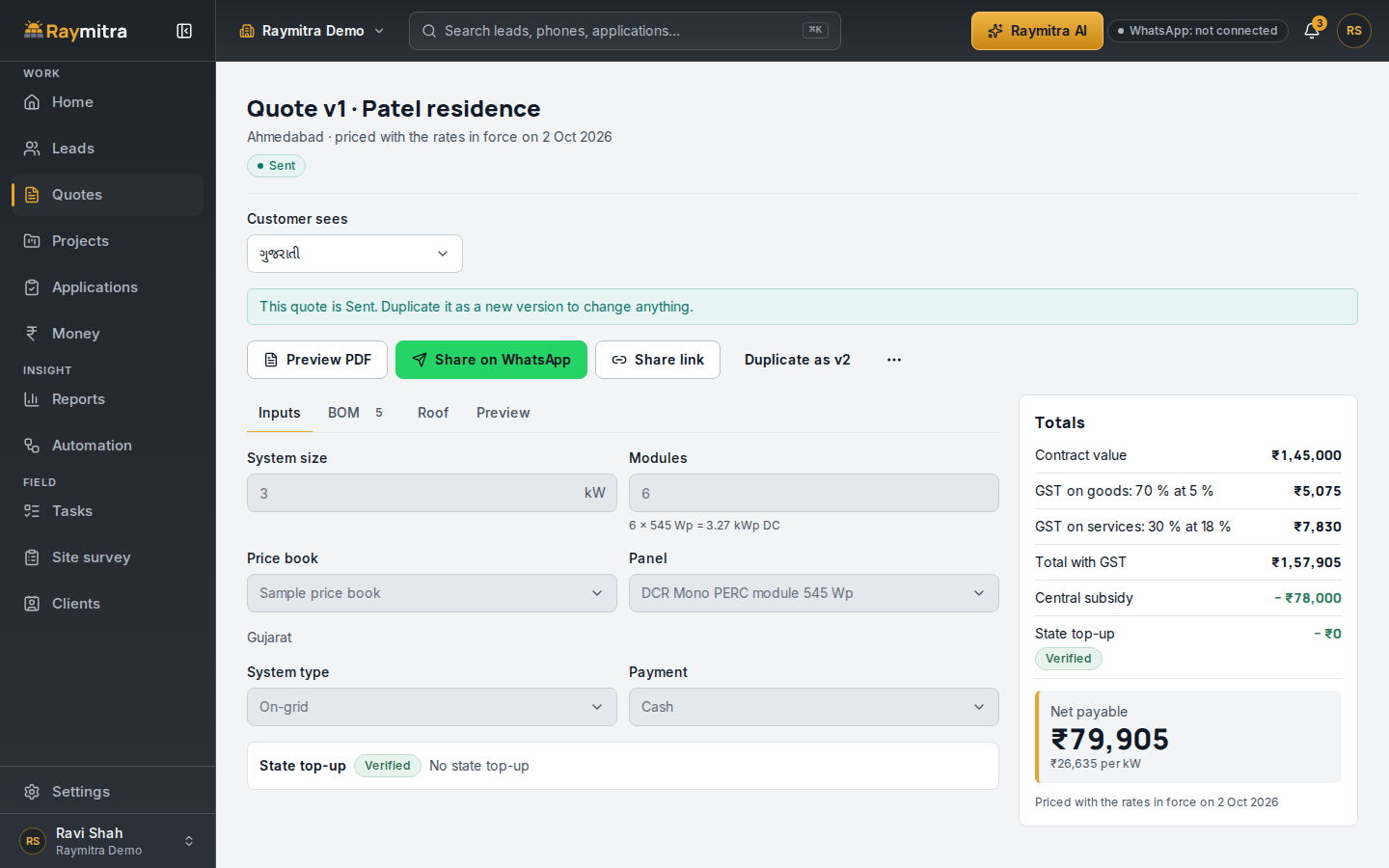
The same quote, made in Raymitra. Choose the size and the price book, and the totals fill in: contract value, both GST lines, the central subsidy, the state top-up with its verified flag, and the net payable. The customer gets a PDF or a link to accept on their phone, in their language.
Frequently asked questions
Should the quote show the price before or after subsidy?
Both. Show the total with GST, which is what the customer pays you, and the net after subsidy, which is what solar costs them in the end.
Can I quote 18% GST on the whole contract?
Not when you supply and install the system together. The notification deems that contract 70% goods and 30% service, so the GST works out to 8.9%.
What if the customer's state has a top-up?
Quote it only if it is confirmed from a government document. Otherwise leave it out and say why.
Try your own numbers in the solar cost calculator.
Related tool: the free solar quotation maker.