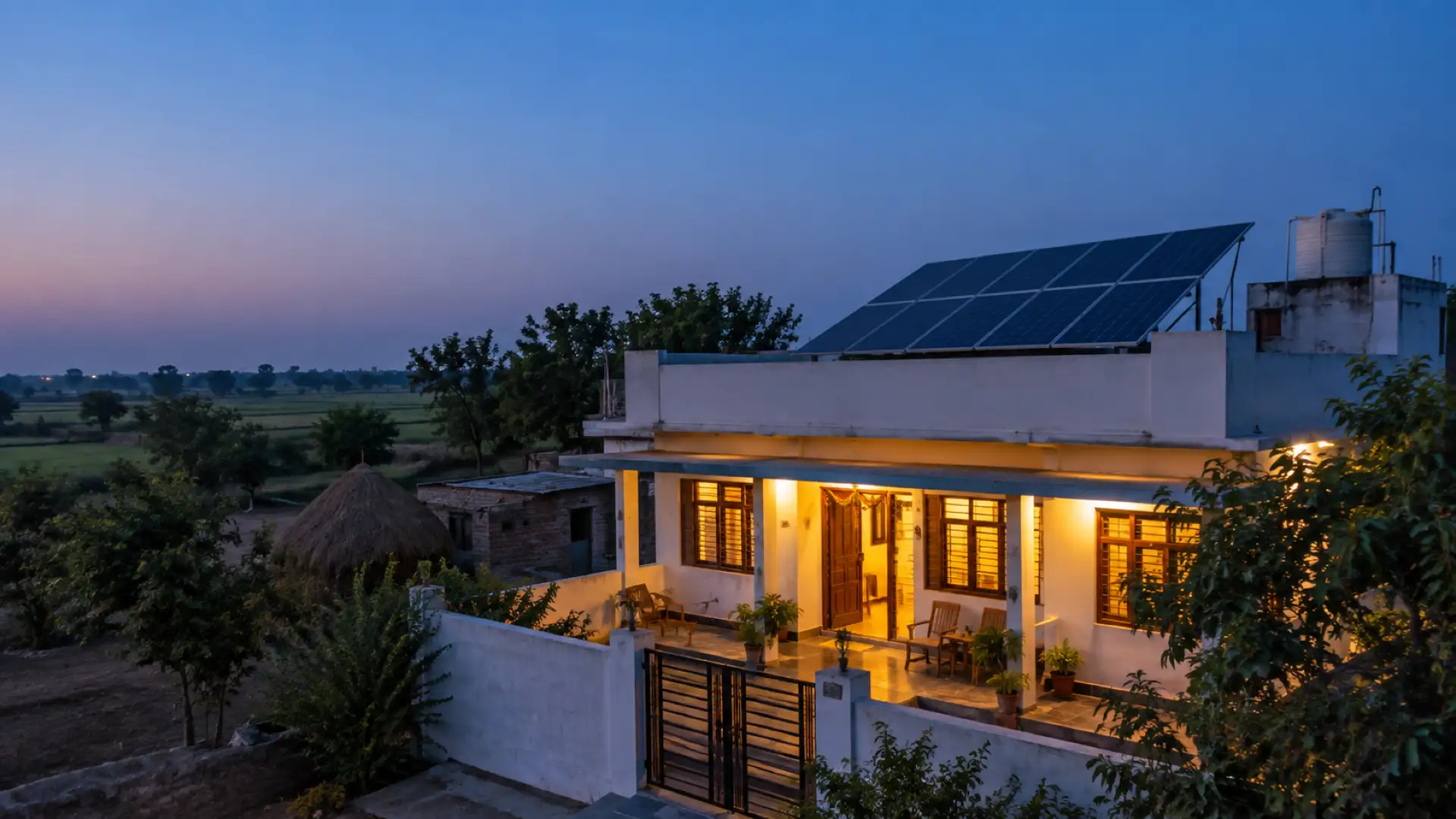
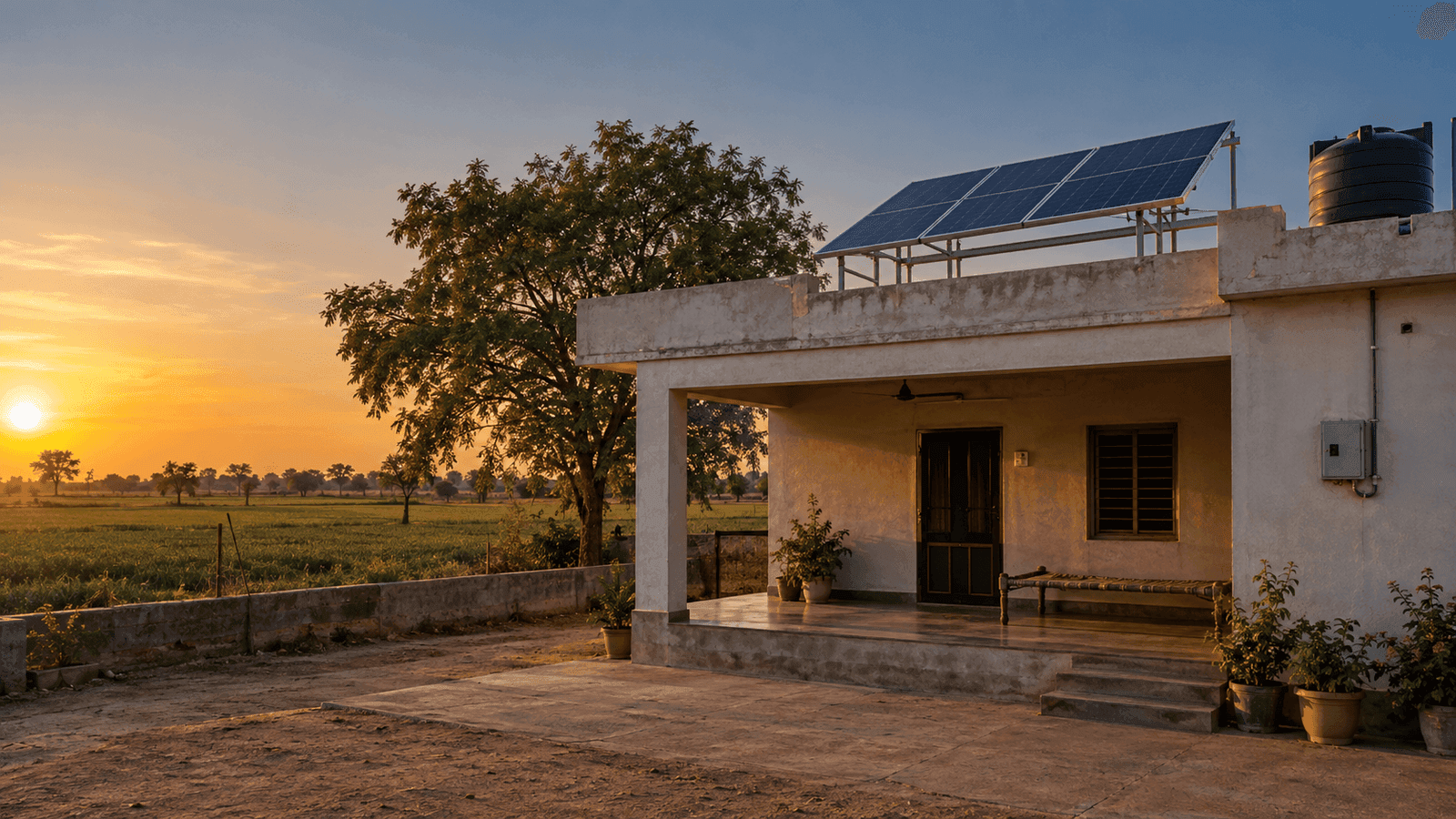
UGVCL (उत्तर गुजरात) में रूफ़टॉप सोलर का नेट-मीटर प्रोसेस: स्टेप, टैरिफ़, बचत का हिसाब और फ़ाइलें कहाँ अटकती हैं।
If the customer's bill says UGVCL, the file runs through the same national portal as every other home in Gujarat. What changes is the office that inspects it and the tariff the saving is measured against. This post gives the steps we can stand behind, the FY 2026-27 tariff to the paisa, and a worked example for a village home, because rural and urban homes in UGVCL are not charged the same.
Where something about UGVCL is not yet confirmed, we say so and point you to the DISCOM.
Who this is for
Uttar Gujarat Vij Company Ltd (UGVCL) is one of the four state-owned DISCOMs in Gujarat, alongside PGVCL, MGVCL and DGVCL. All four bill homes on one common tariff schedule approved by GERC. Torrent Power areas are different and have their own tariff; our Torrent post covers them.
The steps, from registration to subsidy
Our UGVCL net-meter guide lists nine stages. They are the generic PM Surya Ghar flow. The guide gives the ₹2,950 net-meter charge from GUVNL's letter and marks UGVCL's own office and typical days as not yet verified, so check your DISCOM portal for anything local.
- Registered. The consumer registers on the PM Surya Ghar national portal with the consumer number from the UGVCL bill.
- Feasibility. UGVCL checks the connection and the sanctioned load.
- Vendor selected. The consumer picks a registered vendor on the portal.
- Agreement. The consumer approves the agreement with the vendor on the portal.
- Installation. The vendor installs the system and uploads photos and details.
- Net-meter request. The net-meter is requested from UGVCL after installation.
- Inspection. UGVCL inspects the installation and the meter.
- Commissioning. UGVCL issues the commissioning certificate on the portal.
- Subsidy. The central subsidy is credited to the consumer's bank account.
Documents to keep ready
Keep these four ready. MNRE's office memorandum of 11 January 2024 fixed the documents a DISCOM may ask for and told DISCOMs to seek no others, as GUVNL's letter of 28 March 2024 to UGVCL records. If the sub-division asks for more, ask which rule it is under, and write the answer down for the next file.
- The latest UGVCL bill showing the consumer number.
- Bank account details of the connection holder.
- Photos of the installed system.
- The DCR certificate for the panels.
Fees and the meter
For PM Surya Ghar homes, GUVNL set one schedule for all four state DISCOMs, published on UGVCL's solar page (GUVNL letter of 15 February 2024). For 1 to 6 kW: net or generation meter ₹1,014, meter box ₹318, meter testing ₹118 and connectivity ₹1,500, a total of ₹2,950. Above 6 kW and up to 25 kW the total is ₹13,410. The letter is from 2024, so confirm the amount on UGVCL's firm quotation. Show it as its own line, so the customer sees what is UGVCL's charge and what is yours.
The tariff your saving is measured against
GERC's tariff schedule for the four state DISCOMs, effective 1 April 2026, sets the residential (RGP) energy charge. We verified it against the GERC schedule on 30 September 2026.
Urban homes (RGP), per unit, each month:
- First 50 units: ₹3.05
- Next 50 units: ₹3.50
- Next 150 units: ₹4.15
- Above 250 units: ₹5.20
- Fixed charge: ₹15 a month up to 2 kW connected load, then ₹25, ₹45 and ₹70 for the 2 to 4, 4 to 6 and above 6 kW bands.
Rural homes (RGP-Rural), same slab boundaries: ₹2.65, ₹3.10, ₹3.75 and ₹4.90 per unit.
Electricity duty is billed on top of both. The same schedule defines single-phase supply as an aggregate load up to 6 kW, and three-phase above that.
Worked example: 3 kW for a village home
A UGVCL consumer in a village in north Gujarat uses 400 units a month on a rural connection.
The bill today, energy charge only:
- 50 × ₹2.65 = ₹132.50
- 50 × ₹3.10 = ₹155
- 150 × ₹3.75 = ₹562.50
- 150 × ₹4.90 = ₹735
- Total: ₹1,585
With 3 kW of solar. Our rates file plans on 4 units per kW per day. No government source confirms that as an annual average, so treat it as a planning figure. At that rate, 3 kW makes about 360 units a month. If those units are set off against consumption, the home imports a net 40 units: 40 × ₹2.65 = ₹106. The saving is ₹1,479 a month on energy. The fixed charge stays.
What it costs. At MNRE's benchmark of ₹1,45,000 for 3 kW, GST at the blended 8.9% adds ₹12,905. The central subsidy takes off ₹78,000, and Gujarat adds no state top-up, which we verified against the state's own orders. The customer pays ₹79,905. Divided by ₹1,479, that is about 54 months, or four and a half years.
The same 400 units on an urban connection cost ₹1,730, and solar saves ₹1,608 a month, a payback of just over four years. Quote the saving from the tariff on the customer's bill, not from a Gujarat average.
What goes wrong on north Gujarat files
None of these are UGVCL's faults. They are the mistakes that keep a file sitting on the installer's side of the counter.
- The bill is in someone else's name. The portal registers against the consumer number on the bill. If the connection is still in a late parent's name, settle the name first, then apply. Fixing it after installation costs weeks.
- Rural and urban mixed up. Quote a rural customer the urban saving and you overpromise by about ₹130 a month at 400 units. They will notice by the third bill.
- The load band moves. A new AC can push the connected load into the next fixed-charge band. Read the load off the bill at the survey, not from memory.
- The bank account is not the connection holder's. The guide asks for the connection holder's bank details. A son's account on a father's connection is a mismatch waiting to be found.
- DCR paperwork missing at upload. Keep the DCR certificate with the invoice from the day the panels arrive.
- The agreement sits. MNRE's notice of 24 August 2026 tells vendors not to hold applications for more than 60 days without a valid reason. Our tools turn amber at 45 days, our own early warning, so a slow file never becomes a vendor problem.
Frequently asked questions
Is the subsidy in UGVCL areas different from PGVCL or Torrent?
No. The central subsidy is the same everywhere in Gujarat: ₹30,000 per kW for the first 2 kW and ₹18,000 for the third, capped at ₹78,000 (MNRE guidelines, effective 13 February 2024). Gujarat adds no state top-up. Only the tariff, and so the saving, differs.
How much does UGVCL charge for the net-meter?
₹2,950 for a 1 to 6 kW home under PM Surya Ghar, covering meter, meter box, testing and connectivity, per GUVNL's letter of 15 February 2024. Confirm it on the firm quotation and keep it with the file.
How long does a UGVCL net-meter take?
We don't publish typical days until we have enough dated files to back them. Track your own: enter the application date in the application risk checker and it shows how long the file has been open.
Why is the saving lower for a village home?
Rural homes pay less per unit on the same slabs, so every solar unit saves less. At 400 units a month the gap is about ₹130, which adds about four months to the payback.
The UGVCL steps with Hindi labels are in our net-meter guide. Run your customer's bill through the solar cost calculator before you quote the saving.