
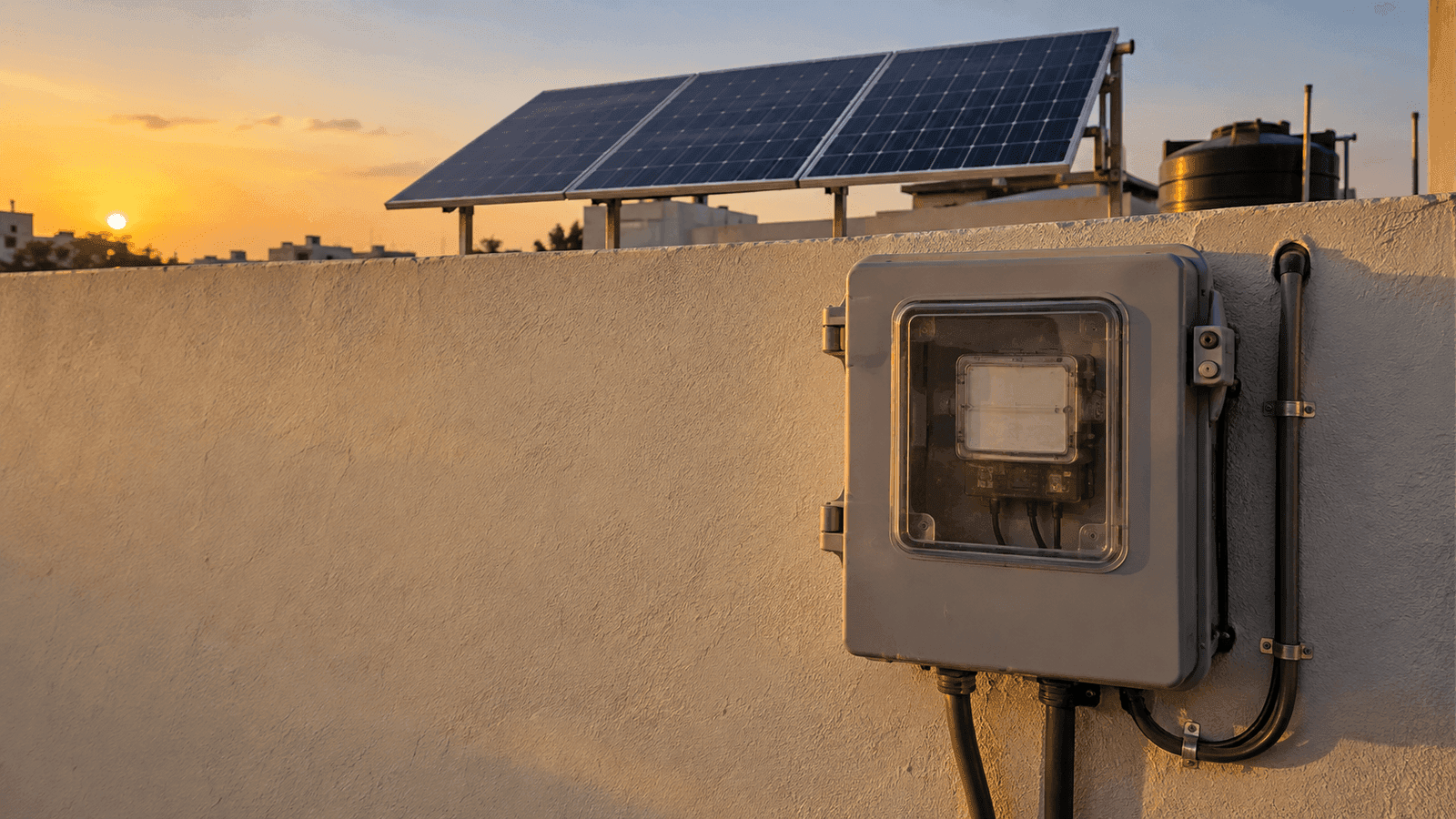
PGVCL (सौराष्ट्र और कच्छ) में रूफ़टॉप सोलर का नेट-मीटर प्रोसेस: स्टेप, डॉक्यूमेंट और टाइमलाइन।
If you install in Rajkot, Jamnagar, Bhavnagar, Junagadh or Kutch, your net-meter file goes to PGVCL. This post lays out the process from the documents PGVCL and MNRE publish, and the timelines the law sets. Where PGVCL's own page is broken or silent, we say so instead of guessing.
Who this is for
Paschim Gujarat Vij Company Ltd (PGVCL) is the state DISCOM for Saurashtra and Kutch, with its corporate office in Rajkot. Its website lists circle offices at Amreli, Anjar, Bhavnagar, Bhuj, Botad, Jamnagar, Junagadh, Morbi, Porbandar, Rajkot City, Rajkot Rural and Surendranagar (pgvcl.com). If the consumer's bill says PGVCL, this is the process.
PGVCL's solar rooftop page carries the forms, meter specifications, a meter supplier list and the interconnection agreements.
The steps, from registration to subsidy
Rooftop solar for homes under PM Surya Ghar runs through the national portal. From clause 6 of the MNRE scheme guidelines:
- Register on pmsuryaghar.gov.in with the consumer number from the PGVCL bill. The portal issues an application ID.
- Feasibility. PGVCL checks the connection. Up to 10 kW, the law treats a complete application as accepted; see the timelines below.
- Choose a vendor registered on the portal, and agree the system and the price.
- Install. The vendor installs, runs the safety checks and briefs the customer.
- Upload. System details and geo-tagged photos go on the portal from the consumer's login.
- Net-meter and agreement. PGVCL installs the bi-directional meter, and the metering agreement is completed.
- Inspection. PGVCL inspects against the portal checklist. It approves, sends the file back for corrections, or rejects it with reasons.
- Subsidy. The e-token activates, the customer redeems it, and the subsidy is processed within 15 days of approval.
Documents to keep ready
From the guidelines, the model vendor agreement and PGVCL's page:
- The latest PGVCL bill showing the consumer number.
- Bank proof in the consumer's name: cancelled cheque, passbook scan or e-statement (clause 6(s)).
- Geo-tagged photos of the installed system (clause 6(j)).
- Module and inverter documents: DCR proof, IEC or BIS reports, serial numbers, warranty cards, the single-line diagram and the structure drawing (Annexure 2, items 4 and 7).
- The project completion report, signed by consumer and vendor (Annexure 2, item 8).
- A self-certificate from the vendor for a system up to 10 kW (a CEI certificate above 10 kW), which GUVNL's firm-quotation conditions for PM Surya Ghar require (GUVNL letter of 28 March 2024, condition 10).
The interconnection agreement
PGVCL publishes a provisional interconnection agreement for residential projects registered on the national portal, to be executed on ₹300 stamp paper.
For PM Surya Ghar systems that agreement is no longer needed. GERC's fifth amendment to its net-metering regulations, published in the Gujarat Gazette on 3 November 2025, says no separate written connectivity agreement is required: the consumer is bound by the regulations, the agreement starts on the commissioning date, and the DISCOM confirms that date and the surplus rate in writing (GERC Notification No. 10 of 2025, clause 3). If the sub-division still asks for stamp paper, show it that notification.
Fees and the meter
For PM Surya Ghar homes, GUVNL set one schedule for all four state DISCOMs, PGVCL included (GUVNL letter of 15 February 2024). For 1 to 6 kW: net or generation meter ₹1,014, meter box ₹318, meter testing ₹118 and connectivity ₹1,500, a total of ₹2,950. Above 6 kW and up to 25 kW the total is ₹13,410. The letter is from 2024, so confirm the amount on PGVCL's firm quotation. The charge sheet linked from PGVCL's own solar page is a January 2017 letter priced with VAT, so it is out of date.
What the law and the agreement do fix:
- The consumer may buy the meter, which the DISCOM then tests and installs (Electricity (Rights of Consumers) Rules, 2020, rule 11(10)). PGVCL lists meter specifications and approved meter suppliers on its page.
- Under PGVCL's agreement, the consumer bears the cost of the system, metering and interconnection (clause 8). Network upgrades are different: GERC's fourth amendment puts the cost of strengthening lines and transformers for a rooftop system up to 6 kW into the DISCOM's revenue requirement, and recovers it per kW above 6 kW (GERC Notification No. 13 of 2024, Regulation 5.1 and clause 8.1 of Annexure IV).
- MNRE's model vendor agreement puts net-meter supply, testing and approvals in the vendor's scope (Annexure 2, item 10). In practice the installer runs it and prices it in.
Timelines the law sets
The Electricity (Rights of Consumers) Amendment Rules, 2024 apply to every DISCOM, PGVCL included:
- Feasibility: within 15 days, or presumed feasible (rule 11(7)).
- Up to 10 kW: a complete application is deemed accepted without a feasibility study, and any sanctioned-load enhancement needed is carried out by the DISCOM (rule 11(7A)).
- Commissioning: connection agreement, meter and commissioning within 15 days of the installation certificate (rule 11(9)).
The guidelines add two more. The subsidy is processed within 15 days of DISCOM approval (clause 6(t)), and grievances are resolved within 30 days (clause 11). If PGVCL delays without just cause, the 2020 rules make it liable to pay the consumer at least ₹500 a day (rule 11(12)).
These are legal maximums, not what happens on the ground. We don't yet have enough dated PGVCL files to publish typical days per step, and we won't guess.
How the bill works after the net-meter
PGVCL's residential agreement (clause 7) settles each billing cycle like this:
- Solar units are set off against units consumed, not against load. Fixed charges stay.
- If the home imports more than it exports, the net units are billed at the normal tariff.
- If it exports more, PGVCL buys the surplus at ₹2.25 per unit for the first five years. After that the rate is 75% of GUVNL's average discovered tariff for non-park solar. This is a term of PGVCL's provisional agreement; where no written agreement is signed, confirm it with PGVCL.
- Credits carry forward. At year end, a balance over ₹100 can be paid out on request.
Worked example: 3 kW in Rajkot on a 2 kW sanctioned load
A Rajkot family uses 300 units a month. The sanctioned load is 2 kW, the connected load is between 2 and 4 kW, and they want 3 kW of solar.
Sanctioned load. GERC's net-metering regulations allow a residential rooftop system irrespective of the sanctioned load (GERC Notification No. 2 of 2022, Regulation 6.2(c)(i)). If PGVCL still wants the load raised, rule 11(7A) says a complete application up to 10 kW is deemed accepted and PGVCL carries out the enhancement. Put the enhancement request in with the application, not after installation.
The bill, before and after
Today, on the GERC urban residential schedule for FY 2026-27, energy and fixed charge only:
- 50 units × ₹3.05 = ₹152.50
- 50 units × ₹3.50 = ₹175
- 150 units × ₹4.15 = ₹622.50
- 50 units × ₹5.20 = ₹260
- Fixed charge for 2 to 4 kW connected load: ₹25
- Total: ₹1,235
With solar: at 4 units per kW per day, a common planning average (reported, unconfirmed), 3 kW makes about 360 units a month. The home exports a net 60 units. The energy charge goes to zero, the ₹25 fixed charge stays, and PGVCL credits 60 × ₹2.25 = ₹135. The monthly saving is ₹1,210 of energy charge plus ₹135 of credit: ₹1,345.
What it says about sizing
At the same planning average, 2.5 kW would make about 300 units, matching this home's use. The subsidy for 2.5 kW is ₹69,000 against ₹78,000 for 3 kW. At MNRE's benchmark cost, the extra half kW costs about ₹15,500 after subsidy and GST, and earns only the ₹135 surplus credit a month. That is close to ten years to pay back that half kW. Size to consumption, not to the subsidy cap.
When feasibility is pending
Past 15 days, the law presumes feasibility (rule 11(7)). Up to 10 kW, no study is needed (rule 11(7A)). The MNRE guidelines add that until a state puts deemed acceptance into practice, the consumer uploads the documents the state asks for (clause 6(h)). So check the portal status and note the date. Then call the sub-division, and raise a portal grievance if nothing moves.
Rejections and resubmission
At inspection the DISCOM can send the application back for corrections or reject it with reasons (clause 6(k)). Record the reason and the date, fix it, and resubmit the same week. Keep every correction reason in one list. Over time it shows which documents your team keeps getting wrong.
Agricultural connections
That is a different scheme. The subsidy here is for residential connections only; the guidelines give none to non-residential consumers (clause 5(d)). Farm solar falls under PM-KUSUM, which PGVCL lists separately on its site.
The PGVCL steps with Hindi labels are in our net-meter guide, and the application risk checker counts the days on any open file.